


Caliper bolts won't go into the caliper!


Moderator
Joined: Mar 2009
Posts: 8,453
From: Belleville, Michigan


The 1" rubber tubes go in the caliper bracket. The ends of the guide pins have a smaller diameter and fit inside the tubes. They must have hi temp synthetic lube on them. If someone used the wrong type of lube, it's possible they swelled up causing the guide pins to bind up on you. Just a thought 

Thread Starter
|
Super Member
Joined: Apr 2013
Posts: 1,029
From: South Carolina midlands
Update on Caliper bolt problem!
I just removed the driver's side caliper and using a 'J hook' made out of a coathanger, I was able to fish out the two old rubber tubes fairly easily. That's the good news. The bad news is-- they weren't deformed or collapsed in any way as I thought they would be. They were hardened from the heat the caliper generates but not to the point they were brittle and would crack with pressure. My AZ Duralast kit p.n. H 5918 has the four new rubber hoses plus four accordion bolt/pin covers and the 8 SS pad clips as shown above. All for only $10.00. Per Capt. Hook's rec. for applying high temp synthetic lube on them , I am going to put it back together. I hope the new bolt /pins will bolt in easily this time and that they will be able to allow the pads to move as they should. I looked at the old pads from both sides and the pad wear was even. Sometimes you see one pad is much more worn than the other which indicates the pads are not able to move as required. Shadetree mechanic's tip: Stock pile some old metal coat hangers for various uses such as these improvised 'J hooks'. The OLDER ones were made of much heavier gauge metal and are better to use than the newer flimsy ones. Both metal styles are being replaced by plastic ones. After a test drive on Mule Trail, I will give you an update. You may have heard of Mule Trail. It is well known in some circles for being the GM Proving Grounds in the Southeast US. Well, maybe not. They are trying to keep it a secret on a need to know basis. V.R., LTJG Jim
Thread Starter
|
Super Member
Joined: Apr 2013
Posts: 1,029
From: South Carolina midlands
Short drive, no problems. I will take it on a longer drive for a better test. I am now thinking about doing the pass. side as well. I didn't have a difficult time re installing the two pins into the caliper on the passenger side like I did on the driver's side, but I feel it would be better long term to have the new rubber hoses replacing the old ones.
Thread Starter
|
Super Member
Joined: Apr 2013
Posts: 1,029
From: South Carolina midlands
I went ahead and pulled the passenger side caliper. Those two rubber tubes also popped out easily with my 'J' hook. These were also in great shape and not collapsed or disintegrated in anyway. Of course, this side hadn't given me any troubles like the driver's side had. I will put the new ones in in the morning. Weather permitting.
Thread Starter
|
Super Member
Joined: Apr 2013
Posts: 1,029
From: South Carolina midlands
Tuesday morning, I got the two new rubber tubes installed on the passenger side. Everything cleaned up and buttoned up and go for a ride. The brakes are quiet , not pulling, and feel great. I am going easy to break them in. I am glad to have everything back together and working well.
I used the 'J' hook and a rag to clean out the hole in the cal. bracket. I used the high temp lube on the outside of the rubber hose and lightly on the smooth portion of the cal. bolt pin.
I used the 'J' hook and a rag to clean out the hole in the cal. bracket. I used the high temp lube on the outside of the rubber hose and lightly on the smooth portion of the cal. bolt pin.
Moderator
Joined: Mar 2009
Posts: 8,453
From: Belleville, Michigan
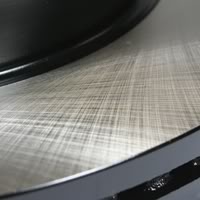
New pads need rotors with a good non-directional finish to help them break in. A "pad slap", (not replacing rotors) is asking for trouble with the new pads. The finish is too smooth, the pads will over heat, the friction material will crack, and they're likely to squeal and fade during braking.
After installing new pads, they need to be "seated in" or "bedded in" or "burnished", (bunch of names for it), DON'T baby them, (worst thing you can do). At ~50MPH, hit the brakes hard until you reach ~10MPH. Don't come to a complete stop, and don't lock them up, but close to it. Bring speed back up to ~50MPH or so and drive a couple of miles to cool the rotors off. A couple of stops like that will seat the pads, they should be quiet and give good service.
After installing new pads, they need to be "seated in" or "bedded in" or "burnished", (bunch of names for it), DON'T baby them, (worst thing you can do). At ~50MPH, hit the brakes hard until you reach ~10MPH. Don't come to a complete stop, and don't lock them up, but close to it. Bring speed back up to ~50MPH or so and drive a couple of miles to cool the rotors off. A couple of stops like that will seat the pads, they should be quiet and give good service.

Starting Member
Joined: Jan 2012
Posts: 195
From: ct.
I am replacing the front disc brake pads on my 2003 Blazer 4WD. The pass. side went slow, but I eventually got it all back together. The driver's side went much smoother and everything was ready to put back together. I compressed the cal. pistons and put the caliper over the new pads. Then I was ready to put the two cal. bolts on. Both the bolts were reluctant to thread onto the ears of the caliper. It was as though there was some obstruction in the caliper or maybe both had been cross threaded on the last pad replacement. Or I thought maybe I had the caliper cocked at an angle and that was preventing the bolts from lining up and threading on. I did put some high temp brake grease on the cal. bolts as you are supposed to. Nothing I tried helped the bolts. It was as though they were hitting another bolt where there shouldn't be a bolt. I finally decided it had to be cross threaded. I didn't have a thread chaser, so I decided to see if I could run the cal. bolt in from the opposite direction. This worked well and I was able to 'rethread' both the top and bottom ears of the caliper. But when I tried to put the cal. bolts back in the right way, they again 'locked up' and wouldn't budge. Both bolts refuse to thread in the ears at the same place. What would cause this? I have never had this happen before. The caliper appears to be seated correctly over the new pads and on the cal. bracket. I didn't remove the cal. bracket since I wasn't replacing the rotors. Any ideas on what may be causing bolt cal. bolts to stop dead at the same spot on the cal. ears?

Thread
Thread Starter
Forum
Replies
Last Post
poepoe624
2nd Generation S-series (1995-2005) Tech
2
Jan 10, 2010 11:48 AM
Boiler_81
Steering, Suspension & Drivetrain
4
Dec 2, 2008 10:04 AM