


P0300 Random Misfire that is killing me.


Thread Starter
|
Beginning Member
Joined: Nov 2009
Posts: 39


Have you performed the crankshaft position sensor relearn and made sure camshaft retard is within spec?
If the timing cover or crank sensor are moved, removed, replaced, or disturbed in any way, the crankshaft position sensor relearn MUST be performed. If it's not done, the engine will still start and run, but ignition timing and injector timing will be incorrect.
If the timing cover or crank sensor are moved, removed, replaced, or disturbed in any way, the crankshaft position sensor relearn MUST be performed. If it's not done, the engine will still start and run, but ignition timing and injector timing will be incorrect.
Since misfires can occur in sooo many ways: one cyl or multiple, only when cold or hot or both, only at idle or high revs or both, etc, I tried to put as much of that info in here as possible because that behavior is a signature of only a certain type of culprit. Meaning if the coil were bad, I don't see how I would have a problem only on #1 and #3. But if I have a vacuum problem I definitely could. I was hoping others could look at the behavior noted in the first post to get their gut instinct.

Moderator
Joined: Mar 2009
Posts: 8,453
From: Belleville, Michigan
The crank sensor is mounted to the timing cover, lower front, passenger side. This is the sensor that generates the pulse for the PCM, (the same as a pick up coil and ignition points do in the distributor on older vehicles). The sensor generates a pulse when the tone ring, (attached to the front of the crankshaft) passes through the magnetic field that the sensor creates. The sensor has a very small, precise area that it is focused on. The relearn "tells" the PCM when #1 piston is precisely at TDC. The relearn data is burned to a memory file in the PCM, and it remains there until the next relearn overwrites it. If the sensor or timing cover move, even slightly, the relearn data, (crankshaft position) is incorrect. The only way to know if the crankshaft position sensor data is correct, is to perform the relearn with a capable scan tool.
The camshaft position sensor, (in the distributor) "tells" the PCM the precise position of the camshaft. When you loosen the distributor hold down and rotate the distributor, you are actually aligning the camshaft position sensor to the camshaft. It will not affect ignition timing. If you unplug the camshaft position sensor, engine performance will not be affected, however, misfire detection and cylinder identification will be disabled. The PCM simultaneously uses data from the crankshaft and camshaft sensors to detect variations in the crankshaft and camshaft speeds in order to determine which cylinder(s) are misfiring. If the relearn data, and or camshaft retard data are not correct, cylinder misfire detection, and cylinder identification is inaccurate. Camshaft retard is viewed on a capable scan tool. Depending on the brand of scanner used, it may be referred to as CMP retard. When diagnosing a misfire, it's always good practice to perform the crank sensor relearn, and check/adjust camshaft retard first, to eliminate a goose chase, a phantom misfire, or an inaccurate identification of the offending cylinder(s).
I agree that it's probably not the ignition coil or ignition module. They both do what the PCM commands them to do. In other words, they're not going to create a misfire on the same cylinders each time... far too coincidental. The important things when diagnosing a misfire, especially P0300, is to do a good visual inspection, and make sure the "basics" are correct: Crankshaft position sensor relearn data, camshaft retard, distributor cap, rotor, distributor shaft bushings**, drive gear, spark plugs, wires, fuel pressure, leakdown, no vacuum leaks.
** Diagnosed very easily when viewing secondary ignition, on a scope in "roster" mode, like this:
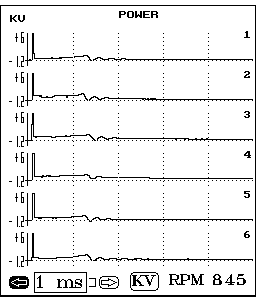
If there is a worn bushing, it sticks out like a sore thumb, to a trained eye
The camshaft position sensor, (in the distributor) "tells" the PCM the precise position of the camshaft. When you loosen the distributor hold down and rotate the distributor, you are actually aligning the camshaft position sensor to the camshaft. It will not affect ignition timing. If you unplug the camshaft position sensor, engine performance will not be affected, however, misfire detection and cylinder identification will be disabled. The PCM simultaneously uses data from the crankshaft and camshaft sensors to detect variations in the crankshaft and camshaft speeds in order to determine which cylinder(s) are misfiring. If the relearn data, and or camshaft retard data are not correct, cylinder misfire detection, and cylinder identification is inaccurate. Camshaft retard is viewed on a capable scan tool. Depending on the brand of scanner used, it may be referred to as CMP retard. When diagnosing a misfire, it's always good practice to perform the crank sensor relearn, and check/adjust camshaft retard first, to eliminate a goose chase, a phantom misfire, or an inaccurate identification of the offending cylinder(s).
I agree that it's probably not the ignition coil or ignition module. They both do what the PCM commands them to do. In other words, they're not going to create a misfire on the same cylinders each time... far too coincidental. The important things when diagnosing a misfire, especially P0300, is to do a good visual inspection, and make sure the "basics" are correct: Crankshaft position sensor relearn data, camshaft retard, distributor cap, rotor, distributor shaft bushings**, drive gear, spark plugs, wires, fuel pressure, leakdown, no vacuum leaks.
** Diagnosed very easily when viewing secondary ignition, on a scope in "roster" mode, like this:
If there is a worn bushing, it sticks out like a sore thumb, to a trained eye

BF Veteran
Joined: Oct 2014
Posts: 4,353
From: North Central Indiana
Verify that your system can correctly detect an induced misfire on each cylinder while monitoring live misfire counts. That will tell you if the misfire detection system is working properly. If it can be verified to be working properly, I personally see no need to do a crankshaft relearn as an intitial diagnostic. If it is not working properly and you have no felt miss, then you are likely detecting false misfires.
I find it odd that you know how to monitor and adjust CMP retard, but don't know anything about crankshaft sensor or cranshaft relearn. That doesn't make sense to me. How certain are you about the CMP retard being zero? What scanner/software are you using to monitor CMP retard? CMP retard being off due to worn distributor gear or other things and the distributor cap/rotor are a couple of the common causes of misfire codes. Listen to the Captain!
I find it odd that you know how to monitor and adjust CMP retard, but don't know anything about crankshaft sensor or cranshaft relearn. That doesn't make sense to me. How certain are you about the CMP retard being zero? What scanner/software are you using to monitor CMP retard? CMP retard being off due to worn distributor gear or other things and the distributor cap/rotor are a couple of the common causes of misfire codes. Listen to the Captain!
Thread Starter
|
Beginning Member
Joined: Nov 2009
Posts: 39
Verify that your system can correctly detect an induced misfire on each cylinder while monitoring live misfire counts. That will tell you if the misfire detection system is working properly. If it can be verified to be working properly, I personally see no need to do a crankshaft relearn as an intitial diagnostic. If it is not working properly and you have no felt miss, then you are likely detecting false misfires.
I find it odd that you know how to monitor and adjust CMP retard, but don't know anything about crankshaft sensor or cranshaft relearn. That doesn't make sense to me. How certain are you about the CMP retard being zero? What scanner/software are you using to monitor CMP retard? CMP retard being off due to worn distributor gear or other things and the distributor cap/rotor are a couple of the common causes of misfire codes. Listen to the Captain!
I find it odd that you know how to monitor and adjust CMP retard, but don't know anything about crankshaft sensor or cranshaft relearn. That doesn't make sense to me. How certain are you about the CMP retard being zero? What scanner/software are you using to monitor CMP retard? CMP retard being off due to worn distributor gear or other things and the distributor cap/rotor are a couple of the common causes of misfire codes. Listen to the Captain!
I was forced to become familiar with CMP retard (which I had NEVER heard of, the same as the bulk of the average users on here!) when I did the LIM gasket procedures due to the crap gaskets the factory put in. Little did I know this stupid motor would require a procedure that 99% of other engines apparently don't require. So, I got the android app and the specific blue tooth scanner that *you* suggested in your other post and dialed it in from the -4.7 degree previous position it was at after dropping the distributor back in to the ZERO degree position at 1,100 rpm.
What does dialing in the CMP retard have anything do to with fiddling around with the crankshaft sensor? Nothing. They are related, sure, but it doesn't mean I have to mess with it, does it? With that said, why would I have had to mess with the crankshaft sensor in the past if I've never had any issues with the car? I wouldn't. So that answers your question why I'm not familiar with it yet I am familiar with CMP retard. Because I've never had to be.
Changing your plugs and wires is related to the coil, yet I have never had to mess with the coil. So there's another example.
I am pretty mechanically inclined, but I did not design this engine so the way I learn is getting my hands dirty over time. Well, I dont go around taking parts off or molesting them that are otherwise working perfectly.

Senior Member
Joined: Oct 2013
Posts: 548
From: Iowa
I knew what a distributor cap was when I was 10. My 7 y/o knows what one is too...
Just sayin' ...
Anyway... My gut is telling me your problem is mechanical, i.e. inside the engine. However, you are in luck! Both the Captain and Les have guts that are much more experienced than mine. If you are willing to listen to them, they will help you figure things out and maybe prove me wrong...
Just sayin' (again )
)
Just sayin' ...
Anyway... My gut is telling me your problem is mechanical, i.e. inside the engine. However, you are in luck! Both the Captain and Les have guts that are much more experienced than mine. If you are willing to listen to them, they will help you figure things out and maybe prove me wrong...
Just sayin' (again
)
BF Veteran
Joined: Oct 2014
Posts: 4,353
From: North Central Indiana
I suggested that you start by verifying that your misfire detection works properly. Only then can you believe you vehicle actually has a real misfire. It's really easy with Car Gauge Pro to monitor misfire counts when you have induced a miss but know I have observed that two of the cylinders end up switched when you hook to a 4.3 Blazer so you have to deal with that.
If you don't want to believe me, then don't and simply take someone else's advice. Getting offended doesn't fix your vehicle, but shaking you out of your mindset just might help.
Best wishes.
BF Veteran
Joined: Oct 2014
Posts: 4,353
From: North Central Indiana
Les
Senior Member
Joined: Oct 2013
Posts: 548
From: Iowa
Thanks CWBDDSPC, but Captain is the #1 resource around here. He has a lot of knowledge in a LOT of different areas. I usually defer to him, but sometimes I think I have my moments in certain areas I have studied a lot. I usually try to limit my help to areas that I know well. Also, I have noticed that the Captain has a LOT more patience than I do! Kudos to him.
Les
Les
I also know you can work your way through a p0300 code pretty well though too, as evidenced by your working with Joe on his. That was an awesome thread to follow...
So, to stay on topic here....
How about inducing a misfire on cylinder 5 or 6 to make sure then misfire detection system is working? Then do whatever the Captain or Les suggests

Thread Starter
|
Beginning Member
Joined: Nov 2009
Posts: 39
Guys, I'm not trying to be hard-headed or argue. Sometimes in writing, the wrong message gets conveyed. So I apologize if thats how it may have come off. You gotta understand, the whole reason I came here is because some people here know more than I do! Les has always shown that he understands these engines pretty well. I know a decent amount, but I dont know it all. And the more I play with this car over the years the more I learn about it. None of us were born understanding these things...we had to learn it over time. And thats my point about the crankshaft sensor...I never had to mess with it, but it looks like maybe I will now. And now I will understand that part just that much better and be able to put one more "part" under my belt in regards to understanding.
So, to answer some questions: Yes, if I induce a misfire by momentarily pulling a plug wire, the misfire counter goes way up on that cylinder, as it should.
Les, Yes, I know that cylinders 1 and 2 misfire are reversed on that app. I induced a misfire to even verify that. So, I fixed that on the app and its not an issue for this troubleshooting procedure. Kudos to you for even finding that out in a prior post cuz thats how I knew to possibly expect that behavior. And sure enough, it was reversed.
I have come here countless times looking at past threads for information and it has been super helpful. So I am hoping this thread will help someone else deal with this headache should they have the same problem as I do.
So my questions:
- Can I remove the crankshaft sensor (when I find where it is) to see if it has the wear that was mentioned by hitting some ring WITHOUT having to do a crank relearn after installing it back?
- How do you test if the misfire system is working, as Les asked? By inducing a misfire? If so, that was already done and the misfires skyrocketed so the misfire system should be fine.
So, to answer some questions: Yes, if I induce a misfire by momentarily pulling a plug wire, the misfire counter goes way up on that cylinder, as it should.
Les, Yes, I know that cylinders 1 and 2 misfire are reversed on that app. I induced a misfire to even verify that. So, I fixed that on the app and its not an issue for this troubleshooting procedure. Kudos to you for even finding that out in a prior post cuz thats how I knew to possibly expect that behavior. And sure enough, it was reversed.
I have come here countless times looking at past threads for information and it has been super helpful. So I am hoping this thread will help someone else deal with this headache should they have the same problem as I do.
So my questions:
- Can I remove the crankshaft sensor (when I find where it is) to see if it has the wear that was mentioned by hitting some ring WITHOUT having to do a crank relearn after installing it back?
- How do you test if the misfire system is working, as Les asked? By inducing a misfire? If so, that was already done and the misfires skyrocketed so the misfire system should be fine.
Last edited by calee4nyaboy; Feb 1, 2016 at 04:18 PM.
Moderator
Joined: Mar 2009
Posts: 8,453
From: Belleville, Michigan
From post #5 above: "If the timing cover or crank sensor are moved, removed, replaced, or disturbed in any way, the crankshaft position sensor relearn MUST be performed. If it's not done, the engine will still start and run, but ignition timing and injector timing will be incorrect."
Post #12 above goes in to detail about the crankshaft position sensor.
Post #12 above goes in to detail about the crankshaft position sensor.