


Best Way to Look for a Vacuum Leak


Thread Starter
|
New Member
Joined: Aug 2011
Posts: 54
From: Alexandria, VA

 Best Way to Look for a Vacuum Leak
Greetings! I have the P0300 code on my 2003 Blazer 4WD V6 4.3L. I have new spark plugs, fuel filter, and fuel pump. When I start the truck in the morning I hear a very audible wooshing sound. Then when I accelerate after driving for 10-15 minutes and try to gain speed, the wooshing sound is back.
Does anyone have an inexpensive, but "tried and true" way of checking for vacuum leaks? I've heard about the carburetor spray can method. I just don't know how to do this - nor do I have a good diagram to check.
And once I find the leak -- how do I know what size vacuum line to buy? Is this listed anywhere??
Thanks in advance!
Does anyone have an inexpensive, but "tried and true" way of checking for vacuum leaks? I've heard about the carburetor spray can method. I just don't know how to do this - nor do I have a good diagram to check.
And once I find the leak -- how do I know what size vacuum line to buy? Is this listed anywhere??
Thanks in advance!
Last edited by run_girl; Aug 3, 2017 at 10:40 AM.

Moderator
Joined: Oct 2014
Posts: 4,340
From: North Central Indiana

OK - you've been unsuccessfully chasing your misfire problem for a while now by replacing various parts. Lots of people have told you lots of things. Some are true, some might be true, and others are way out there. Let's take a step back and think a bit.
You are trying to fix a misfire that is causing serious engine performance problems. Also the SES light is coming on with a P0300 code stored - random misfire, not tied to any particular cylinder. Your brakes are sometimes hard to push. You have recently replaced TPS, cam sensor, and crank sensor. You say that fuel pump, fuel filter, and spark plugs have been replaced but did not specify when or why.
#1. When you replace the crankshaft sensor, you HAVE to do a crank sensor relearn or the misfire detection system will in all probability not work correctly. However, lack of a crank sensor relearn in itself will not cause a misfire. Just don't trust any misfire codes to be correct.
#2. The wooshing sound you refer to...... this might be a large vacuum leak (also might not). I would inspect the PCV valve/brake booster hose area on the intake for disconnected or split/soft/stretchy rubber hoses. If the sound is so loud you can hear it from inside the vehicle, then you should be able to tell where it's coming from pretty easily.
#3 If you have found nothing so far, you can borrow (with deposit) a fuel pressure gauge from most auto part stores. For a quick check of fuel pump and pressure regulator just make sure you get around 60psi when you turn the key on (engine off), and that it doesn't start dropping pressure right afterwards. There is a sticky with extensive fuel pump pressure testing at the top of the second gen forum if a problem is found.
#4 If you still haven't found your problem, next you will need to inspect the electrical system, including checking cam sensor retard. For Cam Sensor Retard you will need a capable scanner. I think you said you had a Wifi OBD2 adapter that you tried to use with some software on your iPhone before. Now you can go get Dash Command for iPhone and buy/install the 2003 GM enhanced PIDs. $10 for the software and $10 for the PIDs. For the rest you will need an ohm meter. Let us know.
I'm betting you will find a large vacuum leak at a hose by the PCV valve.
You are trying to fix a misfire that is causing serious engine performance problems. Also the SES light is coming on with a P0300 code stored - random misfire, not tied to any particular cylinder. Your brakes are sometimes hard to push. You have recently replaced TPS, cam sensor, and crank sensor. You say that fuel pump, fuel filter, and spark plugs have been replaced but did not specify when or why.
#1. When you replace the crankshaft sensor, you HAVE to do a crank sensor relearn or the misfire detection system will in all probability not work correctly. However, lack of a crank sensor relearn in itself will not cause a misfire. Just don't trust any misfire codes to be correct.
#2. The wooshing sound you refer to...... this might be a large vacuum leak (also might not). I would inspect the PCV valve/brake booster hose area on the intake for disconnected or split/soft/stretchy rubber hoses. If the sound is so loud you can hear it from inside the vehicle, then you should be able to tell where it's coming from pretty easily.
#3 If you have found nothing so far, you can borrow (with deposit) a fuel pressure gauge from most auto part stores. For a quick check of fuel pump and pressure regulator just make sure you get around 60psi when you turn the key on (engine off), and that it doesn't start dropping pressure right afterwards. There is a sticky with extensive fuel pump pressure testing at the top of the second gen forum if a problem is found.
#4 If you still haven't found your problem, next you will need to inspect the electrical system, including checking cam sensor retard. For Cam Sensor Retard you will need a capable scanner. I think you said you had a Wifi OBD2 adapter that you tried to use with some software on your iPhone before. Now you can go get Dash Command for iPhone and buy/install the 2003 GM enhanced PIDs. $10 for the software and $10 for the PIDs. For the rest you will need an ohm meter. Let us know.
I'm betting you will find a large vacuum leak at a hose by the PCV valve.
Last edited by LesMyer; Aug 3, 2017 at 11:16 AM.
Thread Starter
|
New Member
Joined: Aug 2011
Posts: 54
From: Alexandria, VA
Size of Hoses?
I did find the vacuum leak! And it was a vacuum leak! I cleared the P0300 code and it has not returned. I put some automotive sealing tape on the leak as a temporary fix until I can leave work and go to a parts store.
I'll answer your questions first to give you a better sense of the history:
[I]#1. When you replace the crankshaft sensor, you HAVE to do a crank sensor relearn or the misfire detection system will in all probability not work correctly. However, lack of a crank sensor relearn in itself will not cause a misfire. Just don't trust any misfire codes to be correct.
I didn't have the crankshaft sensor relearn. I don't have the computer to do that - so should I go to the dealership for this issue?
#2. The wooshing sound you refer to...... this might be a large vacuum leak (also might not). I would inspect the PCV valve/brake booster hose area on the intake for disconnected or split/soft/stretchy rubber hoses. If the sound is so loud you can hear it from inside the vehicle, then you should be able to tell where it's coming from pretty easily.
I think I found the leak (see the image below). I want to replace, just don't know the sizes I need.
#3 If you have found nothing so far, you can borrow (with deposit) a fuel pressure gauge from most auto part stores. For a quick check of fuel pump and pressure regulator just make sure you get around 60psi when you turn the key on (engine off), and that it doesn't start dropping pressure right afterwards. There is a sticky with extensive fuel pump pressure testing at the top of the second gen forum if a problem is found.
As I mentioned, I put some automotive tape on the area that was leaking and everything seems to have reverted back to normal (hooray!)- I just want to properly replace the hoses as this point.
#4 If you still haven't found your problem, next you will need to inspect the electrical system, including checking cam sensor retard. For Cam Sensor Retard you will need a capable scanner. I think you said you had a Wifi OBD2 adapter that you tried to use with some software on your iPhone before. Now you can go get Dash Command for iPhone and buy/install the 2003 GM enhanced PIDs. $10 for the software and $10 for the PIDs. For the rest, you will need an ohm meter. Let us know.
I think I'm good with finding the leak. Just had to take a look around and it was easy to spot. The hose had a noticeable tear/rip from years of use.
I'm betting you will find a large vacuum leak at a hose by the PCV valve.
It was close to the PCV valve (which is new as well) 0 it's that long, skinny hose (see photo).
__________________
My new question is - what size hose to buy? What is the size of the hoses in the Blazer (I'm imagining that there are several that are brittle and I would like to replace as many as possible after all this work I've done)?
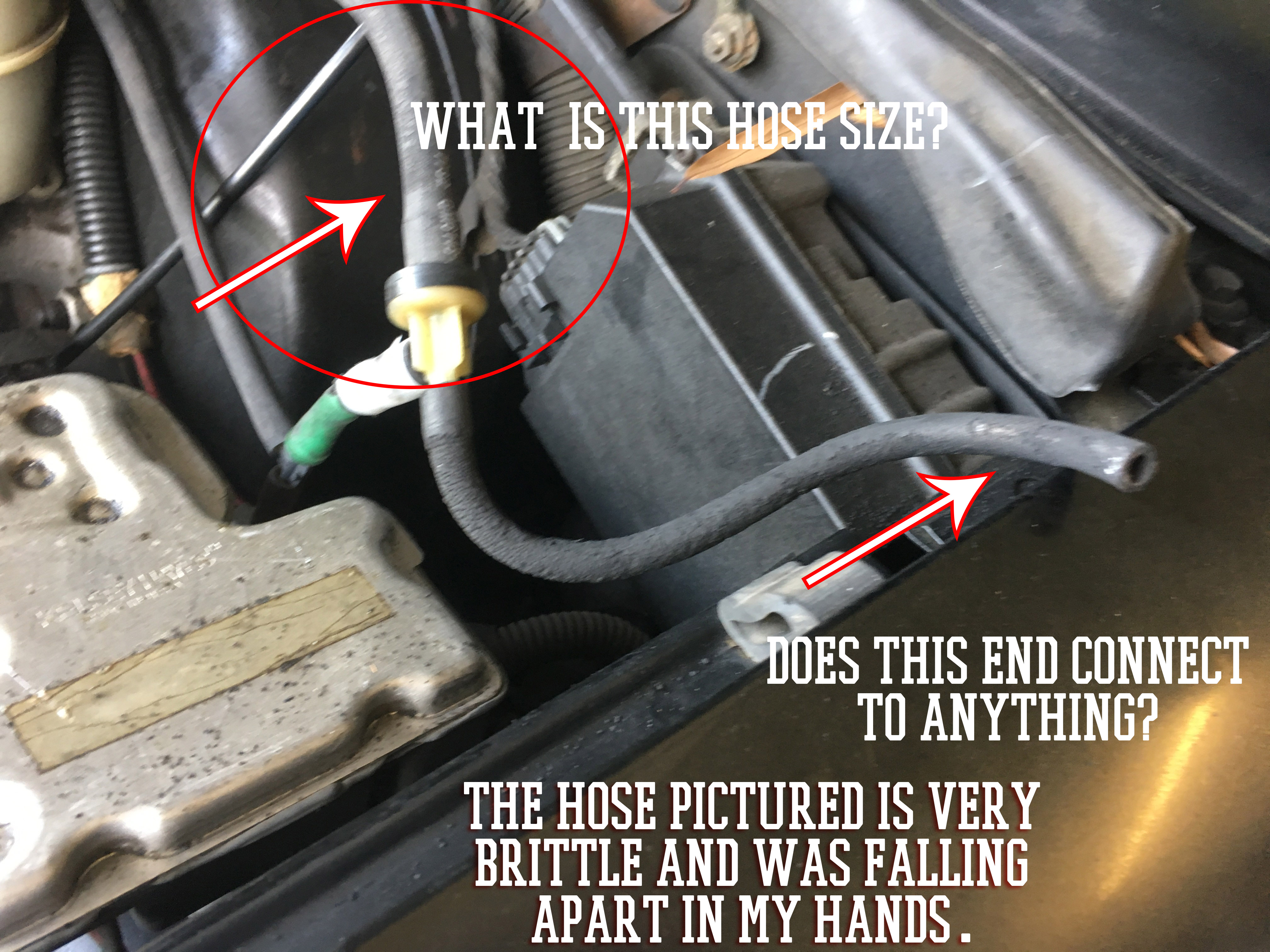
Thanks so much for following my saga. Two weeks ago I decided to stop chasing parts and actually go to a shop. They were more concerned with my oil leak that was located at the oil cooler lines and the oil filter adaptor block. I just ordered the parts from Summit Racing and they should arrive today.
I'll answer your questions first to give you a better sense of the history:
[I]#1. When you replace the crankshaft sensor, you HAVE to do a crank sensor relearn or the misfire detection system will in all probability not work correctly. However, lack of a crank sensor relearn in itself will not cause a misfire. Just don't trust any misfire codes to be correct.
I didn't have the crankshaft sensor relearn. I don't have the computer to do that - so should I go to the dealership for this issue?
#2. The wooshing sound you refer to...... this might be a large vacuum leak (also might not). I would inspect the PCV valve/brake booster hose area on the intake for disconnected or split/soft/stretchy rubber hoses. If the sound is so loud you can hear it from inside the vehicle, then you should be able to tell where it's coming from pretty easily.
I think I found the leak (see the image below). I want to replace, just don't know the sizes I need.
#3 If you have found nothing so far, you can borrow (with deposit) a fuel pressure gauge from most auto part stores. For a quick check of fuel pump and pressure regulator just make sure you get around 60psi when you turn the key on (engine off), and that it doesn't start dropping pressure right afterwards. There is a sticky with extensive fuel pump pressure testing at the top of the second gen forum if a problem is found.
As I mentioned, I put some automotive tape on the area that was leaking and everything seems to have reverted back to normal (hooray!)- I just want to properly replace the hoses as this point.
#4 If you still haven't found your problem, next you will need to inspect the electrical system, including checking cam sensor retard. For Cam Sensor Retard you will need a capable scanner. I think you said you had a Wifi OBD2 adapter that you tried to use with some software on your iPhone before. Now you can go get Dash Command for iPhone and buy/install the 2003 GM enhanced PIDs. $10 for the software and $10 for the PIDs. For the rest, you will need an ohm meter. Let us know.
I think I'm good with finding the leak. Just had to take a look around and it was easy to spot. The hose had a noticeable tear/rip from years of use.
I'm betting you will find a large vacuum leak at a hose by the PCV valve.
It was close to the PCV valve (which is new as well) 0 it's that long, skinny hose (see photo).
__________________
My new question is - what size hose to buy? What is the size of the hoses in the Blazer (I'm imagining that there are several that are brittle and I would like to replace as many as possible after all this work I've done)?
Thanks so much for following my saga. Two weeks ago I decided to stop chasing parts and actually go to a shop. They were more concerned with my oil leak that was located at the oil cooler lines and the oil filter adaptor block. I just ordered the parts from Summit Racing and they should arrive today.
Last edited by run_girl; Aug 3, 2017 at 12:02 PM.
Moderator
Joined: Oct 2014
Posts: 4,340
From: North Central Indiana
The loose hose in your photo goes to a port on the vacuum canister located INSIDE the rear top of your driver's side front fender.
For the hose sizes, just take a razor blade and slit the hoses so they easily come off the check valve in your photo without breaking the brittle plastic. Then take the check valve to the auto parts store and they will help you find the correct vacuum hose sizes.
You will need to find a shop with a high end scanner if you want to do a crank sensor relearn. If no SES light ever and no misfire codes, I wouldn't worry about it. Shop around if you do it. Some might charge $50 others might charge $100 or more.
Best wishes for a successful repair
For the hose sizes, just take a razor blade and slit the hoses so they easily come off the check valve in your photo without breaking the brittle plastic. Then take the check valve to the auto parts store and they will help you find the correct vacuum hose sizes.
You will need to find a shop with a high end scanner if you want to do a crank sensor relearn. If no SES light ever and no misfire codes, I wouldn't worry about it. Shop around if you do it. Some might charge $50 others might charge $100 or more.
Best wishes for a successful repair
Last edited by LesMyer; Aug 3, 2017 at 01:32 PM.

Thread Starter
|
New Member
Joined: Aug 2011
Posts: 54
From: Alexandria, VA
The loose hose in your photo goes to a port on the vacuum canister located INSIDE the rear top of your driver's side front fender.
For the hose sizes, just take a razor blade and slit the hoses so they easily come off the check valve in your photo without breaking the brittle plastic. Then take the check valve to the auto parts store and they will help you find the correct vacuum hose sizes.
You will need to find a shop with a high end scanner if you want to do a crank sensor relearn. If no SES light ever and no misfire codes, I wouldn't worry about it. Shop around if you do it. Some might charge $50 others might charge $100 or more.
Best wishes for a successful repair
For the hose sizes, just take a razor blade and slit the hoses so they easily come off the check valve in your photo without breaking the brittle plastic. Then take the check valve to the auto parts store and they will help you find the correct vacuum hose sizes.
You will need to find a shop with a high end scanner if you want to do a crank sensor relearn. If no SES light ever and no misfire codes, I wouldn't worry about it. Shop around if you do it. Some might charge $50 others might charge $100 or more.
Best wishes for a successful repair

Thread
Thread Starter
Forum
Replies
Last Post


