


Stock ride hieght


Moderator
Joined: Mar 2009
Posts: 8,453
From: Belleville, Michigan


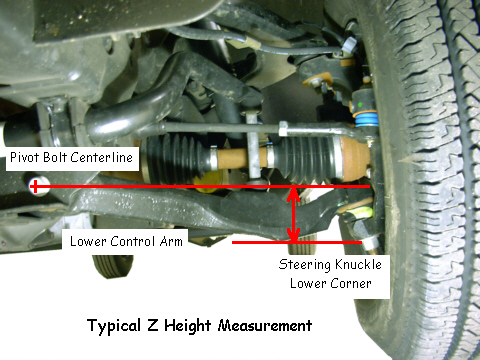
The vehicle must be on a level surface, front to rear, side to side, and corner to corner. Do not jack it up, 1/2 tank of fuel, vehicle loaded as it is most of the time, and if you really want to be accurate, have someone measure it while you are sitting in the driver seat. Measure from the center of lower control arm pivot bolt to the ground. Then measure from the lower most inboard point of the steering knuckle to the ground. Subtract that from the control arm bolt to ground measurement. The result is front chassis ride height. Do the same on each side. Adjustment is done by turning the torsion bar adjusters in the crossmember near the rear of the torsion bars. Check and double check each side after bouncing the vehicle up and down a few times between adjustments.
These specs are for 1996 and newer 4 wheel drive only:
4WD (except ZR2) = 4.6” to 5.0” (4.8” is preferred)
4WD ZR2 = 4.6” to 5.2” (4.9” is preferred)
Rear is measured from the top of the rear axle housing, to the lower edge of the rear axle bumper bracket.
Blazer, Jimmy, Bravada is 5.1" to 5.8"
Pick ups are 5.1" to 6.4"
If it is out of spec, (less than 5.1") the rear springs will need replacement.
If the springs are replaced, allow a month or two for the springs to settle, then check and adjust front chassis ride height. Then have the front end aligned by a competent technician. Also, whenever the torsion bars are adjusted, even the slightest amount, a front end alignment will be necessary, (yes, it's that sensitive).
Last edited by Captain Hook; Mar 21, 2016 at 07:12 PM.

Thread
Thread Starter
Forum
Replies
Last Post
GregC5
Full Size K5 (1969-1991) GMT415 (1992-1994) Tech
2
Jan 8, 2009 10:50 AM