


Towing


Thread Starter
|
Starting Member
Joined: Apr 2013
Posts: 133
From: Catty, PA


The coolant never goes to the transmission. Theres lines that run from the transmission to the radiator that carry the transmission fluid to the radiator. There are two plastic tanks (one on each side of the radiator) one is for the transmission fluid and one is for the engine oil. (the plastic tanks keep the transmission fluid and the oil separate from the coolant.) The radiator cools the coolant, cools the transmission fluid, and the engine oil. (Again, coolant never actually touches the oil or transmission fluid.) The only trouble with that setup, is that when you are towing, the transmission may get a little too warm, and the stock radiator just won't be enough to cool the transmission fluid as well as an aftermarket tranny cooler setup that is dedicated to cool ONLY the transmission fluid. I hope this helps. 
Also Tony H, the cooler I am talking about is a radiator style cooler as far as I can tell.
B&M Plate Style Supercooler Transmission Cooler


Jakeduece posted 100% accurate info. I'll give some further supporting information. The factory coolers are liquid to liquid coolers meaning that the heat transfer is from liquid 1 (transmission fluid or motor oil) to liquid 2 (engine coolant). Aftermarket fluid coolers for this type of application are liquid to air where the air removes heat from the liquid (either transmission fluid or motor oil).
What rexazz2 posted pertaining to the routing of the aftermarket cooler is also what I recommend for anyone in the colder states; installing the aftermarket cooler between the transmission output and the radiator. For warmer states (very little to no exposure to below freezing temperatures), the cooler can be installed either after the radiator or as a complete replacement to the cooler in the radiator. Attached is an image I modified to illustrate the routing discussed above.
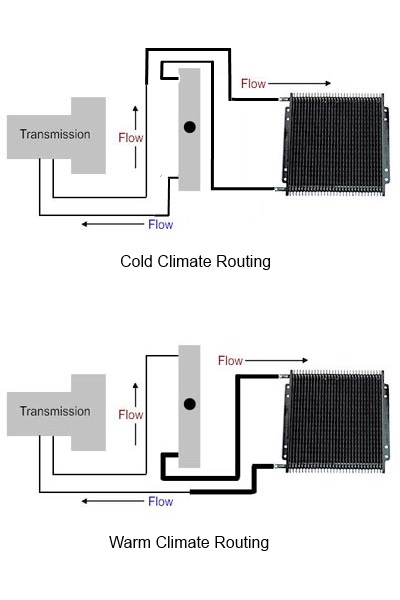
This suggestion pertains to the location of the cooler in the fluid loop, not to the location of the cooler on the vehicle. Auxiliary liquid to air coolers should always be placed in front of the radiator as far as a location on the vehicle goes.
What rexazz2 posted pertaining to the routing of the aftermarket cooler is also what I recommend for anyone in the colder states; installing the aftermarket cooler between the transmission output and the radiator. For warmer states (very little to no exposure to below freezing temperatures), the cooler can be installed either after the radiator or as a complete replacement to the cooler in the radiator. Attached is an image I modified to illustrate the routing discussed above.
This suggestion pertains to the location of the cooler in the fluid loop, not to the location of the cooler on the vehicle. Auxiliary liquid to air coolers should always be placed in front of the radiator as far as a location on the vehicle goes.
Thread Starter
|
Starting Member
Joined: Apr 2013
Posts: 133
From: Catty, PA
Jakeduece posted 100% accurate info. I'll give some further supporting information. The factory coolers are liquid to liquid coolers meaning that the heat transfer is from liquid 1 (transmission fluid or motor oil) to liquid 2 (engine coolant). Aftermarket fluid coolers for this type of application are liquid to air where the air removes heat from the liquid (either transmission fluid or motor oil).
What rexazz2 posted pertaining to the routing of the aftermarket cooler is also what I recommend for anyone in the colder states; installing the aftermarket cooler between the transmission output and the radiator. For warmer states (very little to no exposure to below freezing temperatures), the cooler can be installed either after the radiator or as a complete replacement to the cooler in the radiator. Attached is an image I modified to illustrate the routing discussed above.
This suggestion pertains to the location of the cooler in the fluid loop, not to the location of the cooler on the vehicle. Auxiliary liquid to air coolers should always be placed in front of the radiator as far as a location on the vehicle goes.
What rexazz2 posted pertaining to the routing of the aftermarket cooler is also what I recommend for anyone in the colder states; installing the aftermarket cooler between the transmission output and the radiator. For warmer states (very little to no exposure to below freezing temperatures), the cooler can be installed either after the radiator or as a complete replacement to the cooler in the radiator. Attached is an image I modified to illustrate the routing discussed above.
This suggestion pertains to the location of the cooler in the fluid loop, not to the location of the cooler on the vehicle. Auxiliary liquid to air coolers should always be placed in front of the radiator as far as a location on the vehicle goes.
Last edited by HostileJava; Jun 26, 2013 at 09:54 PM.


ill keep this short because i didnt read the whole thread....
the stock tranny "cooler" like i have been saying forever, and as El Beautor put it, is not exactly a cooler. more of a warmer. like the pictures that Swartlkk put up, there are the tubes from the trans that run to and from the radiator. the radiator is filled with 195° water. that is why your readings for your trans were never below 190. the trans fluid is being heated up the radiator fluid, and same thing with the engine oil. it is done this way because of people that live in the colder climates and the fluid needs to be warm enough for the trans to work properly.
so yeah, you would want to route everything the cold weather way. that way when it comes out the trans hot, you will chill it in the aftermarket trans cooler, then put it back to the correct temp of the radiator.
and as far as what Javier said, they will cool less behind the radiator and the condenser. the reason is air flow and the heat from the other two items flowing backwards from the air coming from the grille. if you can, put it in front of the condenser. this will give you the best possible results and you arent going to be blocking enough of the condenser or the radiator to notice a difference in your A/C or the engine temp.
the stock tranny "cooler" like i have been saying forever, and as El Beautor put it, is not exactly a cooler. more of a warmer. like the pictures that Swartlkk put up, there are the tubes from the trans that run to and from the radiator. the radiator is filled with 195° water. that is why your readings for your trans were never below 190. the trans fluid is being heated up the radiator fluid, and same thing with the engine oil. it is done this way because of people that live in the colder climates and the fluid needs to be warm enough for the trans to work properly.
so yeah, you would want to route everything the cold weather way. that way when it comes out the trans hot, you will chill it in the aftermarket trans cooler, then put it back to the correct temp of the radiator.
and as far as what Javier said, they will cool less behind the radiator and the condenser. the reason is air flow and the heat from the other two items flowing backwards from the air coming from the grille. if you can, put it in front of the condenser. this will give you the best possible results and you arent going to be blocking enough of the condenser or the radiator to notice a difference in your A/C or the engine temp.
Just a correction to what Twip posted above. The passenger side tank on the radiator is the cold tank so the fluid will be no where near 195 degrees; typically down around 120 or so. Engine oil typically warms up to over 195 degrees as well so for both fluid coolers, heat will flow out of the fluid being cooled (trans fluid out engine oil) and into the coolant once everything is warmed up in stock form. With the addition of an auxiliary cooler, at cold temperatures the transmission fluid may be heated up if the aftermarket cooler brings the temp down below that of the passenger radiator tank.
For warmer climates where one would want maximum cooling, used the warm weather routing. Otherwise use the cold climate routing which is what I recommend fit you.
For warmer climates where one would want maximum cooling, used the warm weather routing. Otherwise use the cold climate routing which is what I recommend fit you.

Super Member
Joined: Apr 2013
Posts: 1,029
From: South Carolina midlands
Hostile Java, Captain Hook posted a solution to your dilemma in 4-2013. When the Captain says it, you can tow xxx take it to the bank. Here is his recommendation in the thread 'Towing with 98 Blazer LA 4WD' by the original poster--lt1_madness.
I installed one of these on my 98. 220K miles on the original trans with fluid & filter changes every 36K miles: Buy Imperial Maxi-Kool® XL Transmission Oil Cooler 243012 at Advance Auto Parts It's rated for a class A motorhome towing a 10,000 pound trailer. A bit of overkill for a Blazer, but it's cheap insurance.
It fits perfectly in front of the A/C condenser, passenger side of the hood latch support. Must remove the grille to install it. The OEM trans cooler in the radiator was totally bypassed. At the 200 mile mark of a 250 trip, the scan tool indicated trans fluid temp was 91F, (61F above ambient). Bypassing the OEM cooler allows greater cooling capacity for engine coolant & engine oil as well. Total install time, about 2 hours. I wouldn't pull anything without a cooler on these vehicles.
__________________
I installed one of these on my 98. 220K miles on the original trans with fluid & filter changes every 36K miles: Buy Imperial Maxi-Kool® XL Transmission Oil Cooler 243012 at Advance Auto Parts It's rated for a class A motorhome towing a 10,000 pound trailer. A bit of overkill for a Blazer, but it's cheap insurance.
It fits perfectly in front of the A/C condenser, passenger side of the hood latch support. Must remove the grille to install it. The OEM trans cooler in the radiator was totally bypassed. At the 200 mile mark of a 250 trip, the scan tool indicated trans fluid temp was 91F, (61F above ambient). Bypassing the OEM cooler allows greater cooling capacity for engine coolant & engine oil as well. Total install time, about 2 hours. I wouldn't pull anything without a cooler on these vehicles.
__________________
Super Member
Joined: Apr 2013
Posts: 1,029
From: South Carolina midlands
Please note that the original poster in the thread had a 98 Blazer LS 4WD, not an LA! I recommend that you do a 'search' for additional details on the installation. For example the topic of 'overcooling in winter in cooler climes' comes up in this thread. I like it when a poster gives you a part no. and even the store to buy the needed item. That's nice.

Thread
Thread Starter
Forum
Replies
Last Post
Hellfish
General Chat
0
Nov 11, 2009 09:28 PM
dmoore1200
2nd Generation S-series (1995-2005) Tech
2
Mar 15, 2005 09:52 PM