


Trans oil cooler


Moderator
Joined: Mar 2009
Posts: 8,453
From: Belleville, Michigan


The point of having an add-on cooler is to cool the fluid as much as possible before it enters the transmission. Installing the cooler in the return line cools the fluid before it enters the OE cooler in the radiator. The OE cooler would increase the fluid temp to engine coolant temp, which defeats the purpose of the add-on cooler.
When the engine is at operating temperature, (~198F) using just the OE cooler, trans fluid entering the transmission would be slightly less, and would increase if the engine were to overheat. Transmission fluid life decreases dramatically as fluid temperature increases, so there isn't much room for error. The add-on cooler gives a little "room for error" and by eliminating the OE cooler, if the engine overheats, the transmission in unaffected.
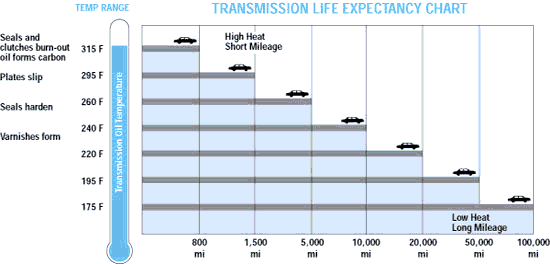
When the engine is at operating temperature, (~198F) using just the OE cooler, trans fluid entering the transmission would be slightly less, and would increase if the engine were to overheat. Transmission fluid life decreases dramatically as fluid temperature increases, so there isn't much room for error. The add-on cooler gives a little "room for error" and by eliminating the OE cooler, if the engine overheats, the transmission in unaffected.
Last edited by Captain Hook; Mar 9, 2014 at 09:25 PM.


The OE cooler does not increase the transmission fluid to thermostat regulating temperature as it is located in the 'cold' tank of the radiator. An infrared thermometer can be used to get an idea of what it is currently running.
Going back a few years with my '00 Bravada, I had installed a B&M Supercooler prior to the factory in-radiator cooler and saw ~190F temps in the return line to the transmission while towing on a 85F day. Prior to that it was up near 230F which the passenger side radiator tank was only around 160F.
Another thing to remember is that too cold means that the fluid will not boil off any moisture which will degrade the fluid properties as well. Coolers with either an external or integrated thermal bypass work the best. For a cold climate, plumbing the cooler in before the factory cooler does give faster warm up times in my experience.
Going back a few years with my '00 Bravada, I had installed a B&M Supercooler prior to the factory in-radiator cooler and saw ~190F temps in the return line to the transmission while towing on a 85F day. Prior to that it was up near 230F which the passenger side radiator tank was only around 160F.
Another thing to remember is that too cold means that the fluid will not boil off any moisture which will degrade the fluid properties as well. Coolers with either an external or integrated thermal bypass work the best. For a cold climate, plumbing the cooler in before the factory cooler does give faster warm up times in my experience.

Thread Starter
|
Super Member
Joined: Oct 2008
Posts: 1,786
From: Tucson, Arizona
Sure appreciate the information; looking at getting one of the B&M Supercoolers, trying to decide which one, the 70255 or the 70264: the difference is in the thickness, one is 3/4", the other 1.5" thick. Not sure if there would be a clearance problem with the thicker one or if the 3/4" is adequate for my vehicle use; no plans of doing any towing, but definitely not living in a cold climate here in Tucson, AZ.
Suggestions?
Suggestions?

Thread
Thread Starter
Forum
Replies
Last Post
LesMyer
2nd Generation S-series (1995-2005) Tech
2
Dec 10, 2014 10:49 PM
DaleA
2nd Generation S-series (1995-2005) Tech
2
Jan 7, 2009 06:54 AM
shooter2499
2nd Generation S-series (1995-2005) Tech
3
Feb 4, 2008 09:23 PM

